Being a member of the League means you help shape the League’s priorities. Through the Program Planning process, members share what they want to see in the year ahead:
- What we should be advocating about
- What we should be educating the community about
- Where we should be focusing our energies to learn more.
The League is grassroots-powered by our members – you.
Read on for more about what Program Planning involves, then how you can get involved this year.
Program Planning Explained
What is the League’s program?
For the League of Women Voters, program is the package of issues chosen by LWV members for concerted study and action in the coming year.
(Click the tab to open each section.)
PURPOSE
There are many important issues on which LWV could have an impact. During program planning, League members examine our advocacy positions to decide whether they are up-to-date and adequate for addressing the important issues our local, state and/or national governments will face in the year ahead. In addition, members suggest various ways the League can work on these issues.
In even years, we focus on local and national positions. In odd years we look at local and state positions.
PROCESS
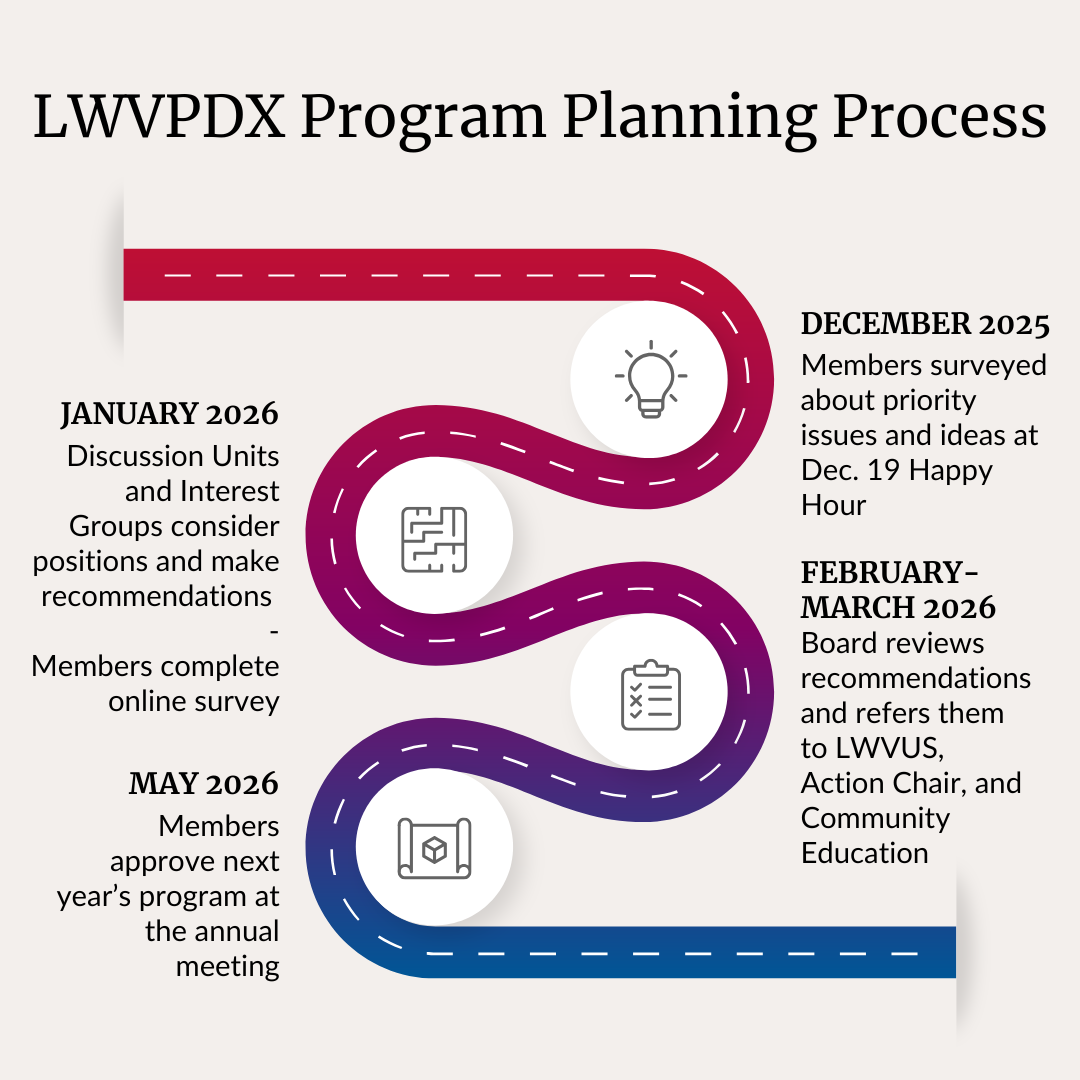
December – (Friday, December 19, 4:30 – 6:00 p.m.) Members meet in-person at the monthly Happy Hour to socialize and share initial thoughts on priority issues.
January – All Portland League members submit their responses to a survey about priority issues on local and national levels.
January – Members attend interest groups and action committee meetings to consider related League positions and make recommendations.
During discussions, attending members decide whether or not the League’s advocacy positions adequately address the issues. They also consider whether any positions need to be restudied. If no position covers an issue, members can propose a new study.
January – Members attend their discussion unit meetings to consider League positions not covered by other groups, and make recommendations.
February to March – Recommendations resulting from the discussions are published in the Voter newsletter and sent to the LWVPDX Board and the LWVUS Board of Directors, who recommend proposals they believe members should adopt.
May – League members or their delegates vote on the various proposals at the local annual meeting and at the state or national convention. The final decisions determine the programs for the following year.
RECOMMENDATIONS
Recommendations about League Positions
Members have five choices for their recommendation about each position under consideration in that Program Planning cycle:
- RETAIN means to keep a position as is, with no change.
- DROP means to remove the position completely from our list; discontinue advocacy. To reactivate requires a new study.
- UPDATE means to update information about the issues addressed by a position or to update wording to conform to current usage, without changing the basic position.
- RESTUDY means to undertake a review of the position to potentially change it.
- ACTION means to refer the position to the Action Committee for advocacy on the issues.
In a given year, the vast majority of positions are retained. However, every position is open to reconsideration.
Other Recommendations
In addition to making recommendations about the advocacy positions and new studies, the discussion groups can propose various LWV activities. For example, they can propose topics for focused League advocacy, community education events, and interest groups. In January or February, Portland League members may also suggest Bylaw amendments and nominees for the LWVPDX Board.
DEFINITIONS
ACTION: a continuous process of working toward goals stated in local, state, and national advocacy positions on public policy issues. Action may involve listening to presentations by public officials, interviewing or lobbying public officials, testifying at public hearings, organizing public forums, contacting the media, joining campaigns for issues we support, informing the public, monitoring governmental functions, and litigating. The Board approves League advocacy.
COMMUNITY EDUCATION: programs for members and the public with prominent speakers on current issues and on League studies. The Community Education Committee also is involved with discussion units, interest groups, study committees, and annual program planning.
CONCURRENCE: an agreement with the exact wording of a statement that may be a position held by another state or local League or a decision statement made by a League board or study committee. The membership must vote to approve a concurrence, before we can use it.
CONSENSUS: a process by which members discuss the findings of a completed study and answer questions developed by the study committee. Consensus reached by members through group discussion is not a simple majority, nor is it unanimity; rather it is the overall “sense of the group” as expressed through the exchange of ideas and opinions, whether in a membership meeting or a series of membership or unit meetings.
INTEREST GROUPS: small groups of members, interested in a topic related to a position, who gather for the purpose of collaborative learning. Interest groups must request and receive approval from the Board in order to function in the name of the League.
POSITION: a statement of the League’s point of view on an issue, derived through member study and agreement (consensus or concurrence) and approved by the appropriate board. Once approved, the position can be used as a basis for League action/advocacy on public policy issues and legislation that relate directly to the position. The LWVPDX can use LWVUS, LWVOR and LWVPDX positions to advocate on local issues.
PROGRAM: the League’s “reason for being,” the basis for both education and action efforts. It consists of those governmental issues that League members choose for concerted study and action, including both adopted positions upon which action is taken and issues for study that will lead to a position and action.
STUDY: extensive, in-depth, balanced research on a public policy issue in order to form a new advocacy position. Studies must be approved by the membership and are conducted by committees of interested members established with board approval. The committee gathers information obtained from researching public documents, conducting interviews with local officials and experts, and further fact-finding activities.
RECOMMENDATIONS ON POSITIONS TO CONSIDER DURING PROGRAM PLANNING:
- RETAIN means to keep a position as is, with no change.
- DROP means to remove the position completely from our list; discontinue advocacy. To reactivate requires a new study.
- UPDATE means to update information about the issues addressed by a position or to update wording to conform to current usage, without changing the basic position.
- RESTUDY means to undertake a review of the position to potentially change it.
- ACTION means to refer the position to the Action Committee for advocacy on the issues.
PORTLAND POSITIONS
Every year, we consider whether we need any updates or additions to our Portland positions.
https://lwvpdx.org/wp-content/uploads/2023/06/LWVPDX-Positions-June-2023.pdf
NATIONAL POSITIONS
In 2026 (as we do every other year), we consider LWVUS positions.
Get involved
Members can share their voice in the League’s Program Planning process in multiple ways this winter:
All-member In-person Conversation and Program Planning Kick-off
Friday, December 19 – 4:30 – 6 p.m. at Leikam Brewing, 5812 East Burnside, Portland
Members meet in-person at the monthly Happy Hour to socialize and share initial thoughts on priority issues.
Discussion Units, Interest Groups, Action Committee
Meet with your group in January to discuss a subset of our League positions and make recommendations about updates or new studies needed.
Upcoming meetings:
- Wednesday, January 14 at 10 a.m. – Ranked Choice Voting Committee (Zoom) Melanie Billings-Yun, Leader
- Thursday, January 15 at 1 p.m. – Discussion Unit 4 (In-person) Lynn Baker, Leader
- Monday, January 19 at 12 p.m. – Discussion Unit 7 (Zoom) rhyen enger, Leader
- Thursday, January 22 at 2:30 p.m. – Portland City Government Interest Group (Zoom) Wynne Furth, Leader
- Saturday, January 24 at 10:30 a.m. – Discussion Unit 5 (In-person) Linda Mather, Leader
- Monday, January 26 at 10 a.m. – Discussion Unit 2 (Hybrid) Barbara Byrd, Leader
- Monday, January 26 at 5:30 p.m. – Discussion Unit 3 (Zoom) Olivia Smith, Leader
- Tuesday, January 27 at 3:30 p.m. – International Relations Interest Group (Zoom) Linda Jackson, Leader
- Tuesday, January 27 at 1:30 p.m. – Action Committee (Zoom) Debbie Aiona, Leader
- Wednesday, January 28 at 9:30 a.m. – Discussion Unit 6 (Hybrid) Margaret Noel and Norman Turrill, Co-Leaders
For meeting information, contact the Leader(s) if you are not already on their contact list or reach out to the Office Manager at info@lwvpdx.org.
Member Survey Online
Take our online survey before January 31. Members will receive the link via email in early January.